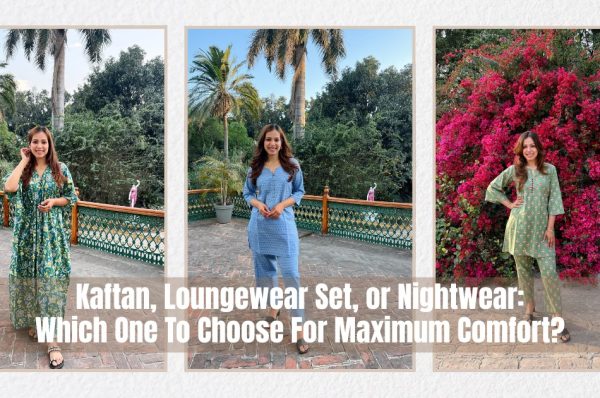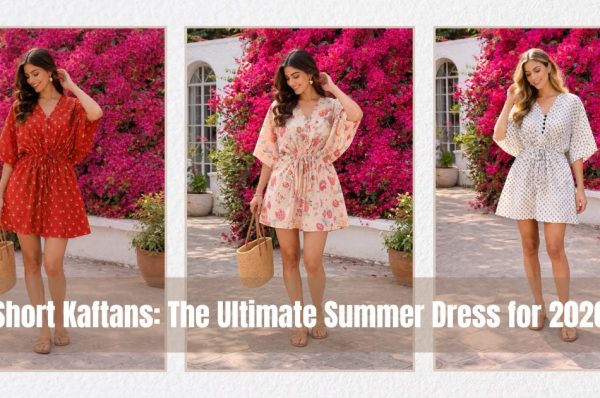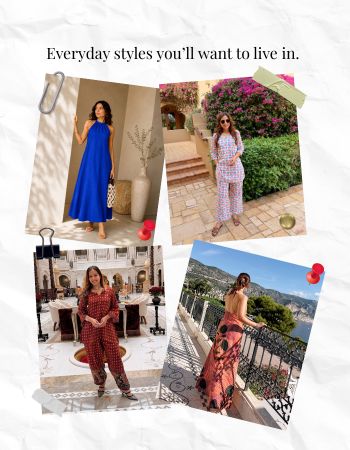
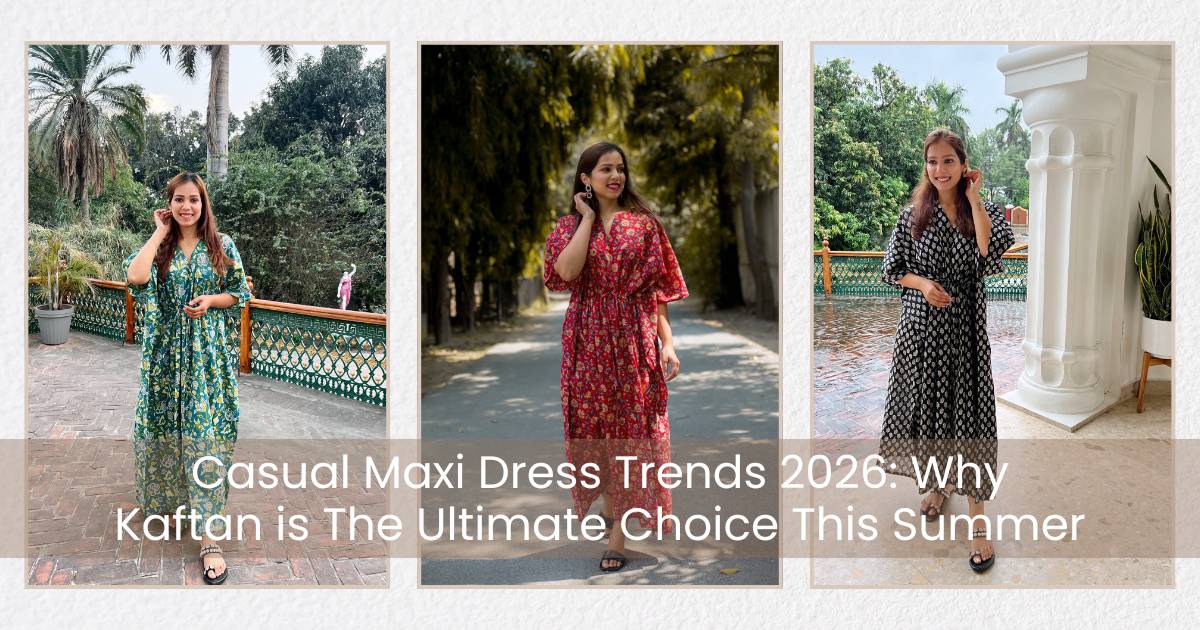
Indian women’s summer wardrobes have shifted. In 2026, the dominant category is no longer fitted western dresses or structured salwar suits — it’s the kaftan. Loose, breathable, print-forward, and genuinely effortless: the kaftan has gone from “resort wear” to the most-worn style across North and Central India for anyone who spends time outdoors in the heat.
Why Kaftans Are Leading Summer 2026 in India
The Indian ethnic wear market is growing at 7.9% CAGR and is valued at USD 25.72 billion in 2026 (Business Research Insights). Within that market, kaftans and contemporary silhouettes are among the fastest-growing segments — driven by a consumer shift toward comfort-first clothing that also reads as put-together. The Indian ethnic wear market is dominated by women’s wear at approximately 68% of total revenue, and the fastest-growing product categories in 2025–2026 are kurtas, kaftans, and co-ord sets that blur the line between loungewear and outerwear.
Three forces are converging in 2026 to make kaftans the dominant summer style:
- The comfort-first shift: Post-2020, Indian women have permanently adjusted their relationship with comfort clothing. Styles that feel like loungewear but look like proper outfits are winning.
- Climate realities: North India recorded temperatures of 40°C+ as early as March 2024 (IMD data). The kaftan — loose-fitting, natural-fabric, free-moving — is functionally the best garment for this weather.
- Print culture: Indian women love prints. The kaftan’s flat, wide canvas is perfect for the bold florals, geometric block prints, and tropical patterns that have dominated fashion feeds in 2025–2026.
2026 India Summer Kaftan Trends: What the Data Shows
Rangaari’s own search traffic for the kaftan and maxi dress category has grown steadily through 2025–2026. Across Google Search, the dominant query patterns we’re seeing for kaftans in the North India market are:
- “Cotton kaftan dress for summer” — high commercial intent, strong volume
- “Short kaftan for women India” — growing rapidly, particularly in the 25–40 age group
- “Kaftan kurta set” — the co-ord format is gaining ground over single-piece kaftans
- “Kaftan for home wear” — confirming the blurring between loungewear and outerwear
The colour palette dominating in 2026: muted pastels (sage green, dusty rose, powder blue), earthy tones (terracotta, sand, olive), and bold tropicals (hibiscus prints, mango yellow, deep teal). Block prints from Jaipur and Bagru are particularly strong — they read as authentically Indian while remaining fresh.
5 Types of Kaftan Dresses — and When to Wear Each
1. Short Kaftan (Knee-Length)
The most versatile piece for everyday summer use. A knee-length kaftan can be worn to the market, to a casual brunch, or while working from home. At Rangaari, our short kaftans are made from 100% cotton with breathable fabric weights that stay cool past the 40°C mark. Pair with kolhapuris or flat sandals; add a cotton dupatta if you want more coverage.
2. Maxi Kaftan (Floor-Length)
The maxi kaftan has crossed over from resort wear into everyday fashion in 2026. For Indian summers, a floor-length kaftan in white or light prints is an elegant choice that provides full-body sun coverage while remaining airy. Best for evenings, family visits, and occasions where a kurta set would feel too formal but jeans would feel too casual.
3. Kaftan Kurta Set
The co-ord kaftan set — a kaftan-style kurta paired with wide-leg pants or palazzos in the same print — is the 2026 trend to watch. It looks more put-together than a single-piece kaftan, reads as festive-ready, and can be worn across occasions from office casual to family celebrations. The key is in the fabric and print: a cotton-linen blend in a subtle block print works for office; a rayon or georgette in a bold print works for events.
4. Kaftan with Side Slits
Side slits improve mobility in longer kaftans without compromising modesty. This detail — borrowed from traditional kurta design — makes a maxi kaftan more practical for daily movement. Look for slits that open at knee height or above for maximum freedom of movement.
5. Printed Cotton Kaftan for Home Wear
The most searched kaftan query in Rangaari’s data is the home-wear category. A good cotton kaftan in a cheerful print effectively replaces both nightwear and casual indoor wear — it’s comfortable enough to sleep in and presentable enough to answer the door or step out briefly. This is the “workhorse” kaftan that sells year-round at Rangaari.
Rangaari Kaftan Sizing Guide
Sizing consistency is a common frustration with kaftans because the loose silhouette can make it hard to know which size to choose. At Rangaari, our kaftans are sized by your shoulder and bust measurement, not your waist — because the waist is fully free-fitting in a kaftan design. Here’s the general guide:
| Size | Bust (approx.) | Length (maxi) | Length (short) |
|---|---|---|---|
| XS | 30–32 inches | 52–54 inches | 40–42 inches |
| S | 32–34 inches | 52–54 inches | 40–42 inches |
| M | 34–36 inches | 53–55 inches | 40–42 inches |
| L | 36–38 inches | 53–55 inches | 40–42 inches |
| XL | 38–40 inches | 54–56 inches | 41–43 inches |
| XXL | 40–42 inches | 54–56 inches | 41–43 inches |
| XXXL | 42–44 inches | 54–56 inches | 41–43 inches |
Every product page at Rangaari lists the model’s height (typically 5’3″) and the wearing size so you can use the model photo as a visual reference alongside the size chart.
How to Style a Kaftan This Summer
The kaftan’s strength is its versatility, but that same looseness can make styling feel uncertain. Here’s how Rangaari recommends building looks around a kaftan:
- For everyday casual: Short printed kaftan + flat leather sandals or kolhapuris. No dupatta needed. Let the print do the work.
- For a family visit or lunch: Maxi kaftan with subtle print + block-heel sandals + minimal silver earrings. Pin a dupatta at one shoulder for a more dressed-up look.
- For the office (business casual): Solid or muted-print short kaftan + straight-fit trousers underneath + pointed flats. Works in AC environments.
- For evenings or events: Kaftan kurta set in a bold print or embroidered fabric + heels + statement earrings. The co-ord format reads as intentionally styled.
Internal link for fabric guidance: For the full breakdown of how cotton and linen kaftans perform differently in Indian heat, read our cotton vs linen for summer guide.
Kaftan Fabric Guide: What Works for Indian Summer
Not all kaftans are equal when it comes to India’s summer conditions. The fabric determines whether your kaftan stays cool through a 40°C afternoon or becomes uncomfortable by midday. Here’s what to look for:
- 100% Cotton: The standard for Indian summer. Absorbs sweat before it feels wet, breathes well in humidity, and softens with every wash. Rangaari kaftans are cotton by default — not a premium tier. Best for everyday wear, home, and outdoor errands.
- Cotton-Linen: Linen fibres can absorb up to 20% of their own weight in moisture — nearly three times pure cotton’s absorption capacity (Georgia Institute of Technology research). A cotton-linen kaftan stays dry longer in high-humidity conditions. Best for long outdoor events, travel, and beach wear.
- Cotton Voile / Mulmul: Ultra-lightweight and sheer; best layered or worn with a slip. The most breathable option but less durable than regular cotton. Best for formal occasions and occasions that are short in duration.
- Avoid: Polyester, georgette blends, and viscose-heavy fabrics in summer — they look good but trap heat and cause skin friction in sustained wear above 35°C.
Kaftan Care: Keeping Colours Vibrant Through Summer
Rangaari printed kaftans use reactive dyes on cotton — here’s how to keep the print quality intact through regular summer washing:
- First wash: Cold water, separate (colours may bleed slightly on the first wash — this is normal for reactive-dyed cotton and settles after the first wash).
- Subsequent washes: Cold to lukewarm water, inside-out to protect the print surface.
- Drying: Shade-dry always — direct summer sun fades reactive prints faster than winter sun. A kaftan shade-dried regularly will hold its print quality through 50+ washes.
- Ironing: Low to medium heat, inside-out. The kaftan’s loose structure means it rarely needs ironing — a light steam is usually sufficient.
Rangaari’s 2026 Kaftan Collection: What to Expect
Rangaari’s kaftan range for 2026 focuses on three core design directions: bold botanicals (large-scale floral prints on white and off-white cotton), earthy geometrics (block-print inspired patterns in terracotta, olive, and indigo on natural cotton), and solid-with-border (plain cotton kaftans with woven or printed border detailing along the hem and sleeve edges — a quieter choice for women who prefer minimal pattern).
All Rangaari kaftans are available from XS to XXXL with in-between measurements listed on each product page. Standard delivery is pan-India and takes 3–7 working days. For customisation requests (length adjustments, neckline variations), contact Rangaari directly before placing an order — most standard adjustments can be accommodated at no additional cost.
The full kaftan collection is available at the Rangaari kaftan store. New designs are added each month — bookmark the page or follow Rangaari on social media to stay updated on new arrivals.
Frequently Asked Questions
A 100% cotton kaftan in a lightweight fabric weight (below 120 GSM) is the best choice for Indian summers. Cotton breathes well, absorbs sweat before feeling damp, and stays soft against heat-sensitive skin. For evenings or longer events where you’ll be indoors in AC for part of the day, a cotton-linen blend gives better structure while remaining breathable.
Yes — in most Indian office environments, a kaftan in a solid colour or subtle print works as business casual. Pair it with straight trousers underneath and closed-toe footwear for a more formal look. The key is the print: avoid very bright or large prints for professional settings. Rangaari’s short kaftans in muted colours or classic block prints are office-appropriate.
A kaftan is traditionally a loose, unstructured tunic-style garment with wide sleeves and minimal seaming, rooted in Middle Eastern and South Asian textile heritage. A maxi dress typically has more structure — a waistline, fitted bodice, or designed silhouette. Kaftans are generally more practical for Indian summer heat because their loose construction allows more air circulation than a structured maxi dress.
Yes. Rangaari kaftans are available in sizes XS to XXXL. The loose kaftan silhouette is particularly well-suited to inclusive sizing because it doesn’t rely on precise structural fitting — a size XL kaftan drapes just as beautifully as an XS one.
Machine wash in cold water on a gentle cycle, or hand-wash. Avoid spin-drying — squeeze gently and hang to dry in shade (direct sun can fade block prints). Iron on medium heat while slightly damp for the smoothest finish. Don’t dry clean unless the care label specifies it.
Niharika’s Note
Kaftans became Rangaari’s hero product almost by accident. Customers in Pilibhit kept asking for “something I can wear all day at home but also step out in without changing” — and nothing in the market fit that brief. Cheap synthetic kaftans looked cheap; the embroidered, expensive ones were too formal for a Tuesday. I chose kaftans deliberately because the silhouette solves a real problem for Indian women managing 40°C+ summers: loose enough to breathe, structured enough to look intentional. We build ours in 100% cotton or cotton-linen blends with real block prints, not screen-printed patterns that fade in two washes. I still test every new kaftan style myself through a full Pilibhit summer day — kitchen, errands, evening visitors — before it goes into production. If it survives that day comfortably, it goes on the site.
— Niharika Agarwal, Founder, Rangaari
Browse the full Rangaari kaftans collection or the short kaftans range. For fabric questions or feeding-friendly options, contact us.