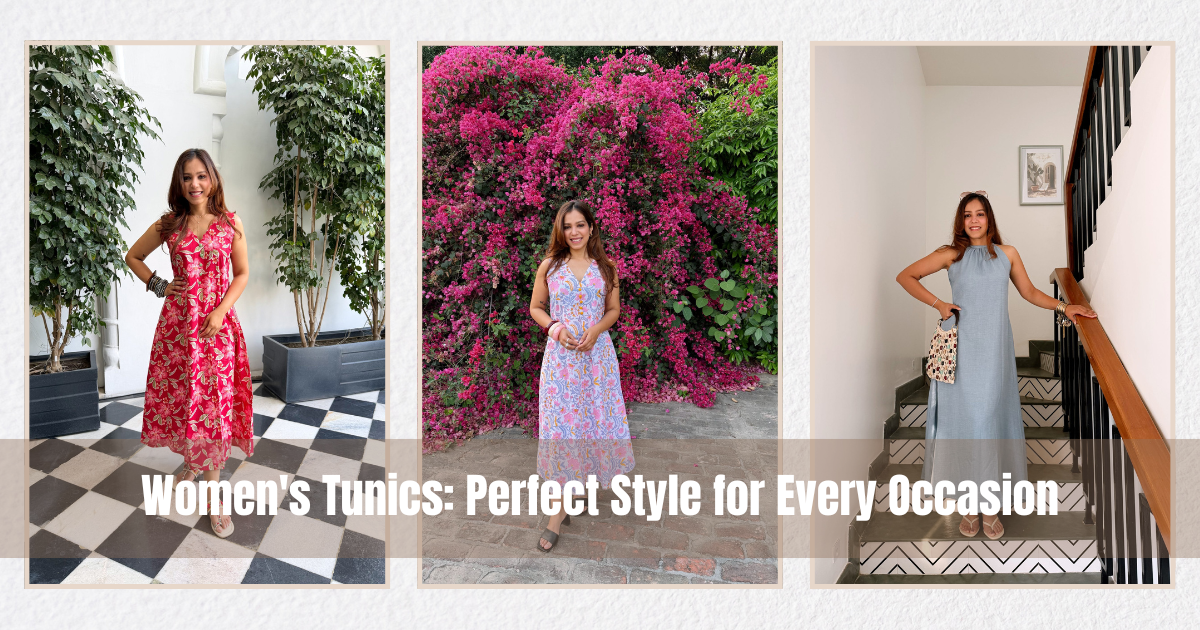
Picking the right tunics for women should be simple until you are standing in front of a dozen options wondering why some look effortless on the rack and awkward on you. The answer is almost always body type, fabric, or occasion mismatch. This guide fixes all three.
A tunic is a hip-to-thigh-length top, longer than a regular shirt, shorter than a full kurta worn with leggings, jeans, palazzos, or churidars. In the Indian ethnic-wear context, tunics blend Indo-Western design with everyday comfort: think block-printed cotton, relaxed linen, or flowy rayon with ethnic motifs that work equally well for college, office, and festive occasions.
In this guide, Niharika Agarwal, Founder and Lead Stylist at Rangaari breaks down exactly how to choose a tunic for your body shape, the Indian climate, and every occasion on your calendar.
What Is a Tunic? Tunic vs. Kurti vs. Kurta – Cleared Up
These three terms are used interchangeably in Indian fashion, but they are not the same piece of clothing. Getting this right saves you from buying the wrong length every time.
| Tunic | Kurti | Kurta | |
|---|---|---|---|
| Length | Hip to mid-thigh | Hip to thigh (often below) | Knee to ankle |
| Silhouette | Fitted or relaxed, often structured | Relaxed, ethnic detailing | Relaxed to full, formal |
| Western styling? | Yes, pairs with jeans, straight trousers | Partially | Rarely |
| Paired with | Jeans, leggings, palazzos | Leggings, churidars | Churidars, salwars |
| Best occasion | Casual, office, festive | Everyday to semi-formal | Festive, formal ethnic |
A tunic is the most versatile of the three, it transitions from office to evening with a simple footwear swap. For a side-by-side breakdown of all three, read Kurta vs Kurti vs Tunic – The Complete Guide.
Tunic Length Guide: Mini, Midi, and Maxi – When Each Works
Length is the first decision and the one most women skip. It affects proportion, occasion-suitability, and how flattering the overall look is.
Mini Tunic (Hip-Length: 26–30 inches)
Best for: layering over leggings, wearing with high-waist jeans, college outings, casual weekend wear.
A hip-length tunic worn with slim-fit or straight jeans creates a clean, balanced proportion especially for petite frames. The key is a defined neckline to anchor the look. Avoid pairing a very short tunic with wide-leg trousers: the hem gets visually absorbed and the outfit looks unfinished.
Midi Tunic (Thigh-Length: 34–40 inches)
Best for: office wear, family occasions, daily ethnic styling, kurta-set alternatives.
The thigh-length tunic is the most requested length at Rangaari. It covers the hip and thigh without adding bulk, works on almost every body type, and photographs well. Pair with straight-cut palazzos or churidars to maintain the proportional line. This is also the most occasion-flexible length, appropriate from 9 AM at the office to 7 PM at a family dinner.
Maxi Tunic or Long Tunic (Knee-Length: 42–48 inches)
Best for: festive occasions, family functions, maternity wear, formal ethnic events.
A knee-length tunic creates ethnic elegance, especially in georgette, crepe, or embroidered cotton. It is also the most forgiving fit for plus-size and maternity dressing since it draws attention to the legs rather than any single zone of the body. Pair with fitted churidars or cigarette pants; avoid wide palazzos (too much fabric overall).
Tunics by Body Type: The Guide No Competitor Provides
The most common reason a tunic that looks stunning in a product photograph feels wrong when worn: it was not chosen for the right body type. Here is a body-by-body breakdown.
Apple Body Type (Fuller Midsection, Broader Shoulders, Slimmer Legs)
Your goal: create vertical length through the torso and draw attention to your legs.
What works:
- A-line tunics that flare gently from the bust, not the waist
- V-necklines and deep-scoop necks that elongate the neck and open the chest
- Darker solids or subtle vertical prints through the torso
- Midi length (thigh) so the eye travels downward to the leg
What to avoid:
- Empire-waist tunics where the gather sits at the widest point
- Bold horizontal prints across the midsection
- Very short hip-length tunics with skinny jeans leaves no visual resting point
Fabric recommendation: A mid-weight cotton or rayon in a deep jewel tone (navy, dark green, burgundy) with a clean V or scoop neckline. The fabric weight should be sufficient to drape smoothly, not cling.
Pear Body Type (Narrower Shoulders, Fuller Hips and Thighs)
Your goal: add visual width and detailing above the waist to balance the lower body.
What works:
- Embellished or printed necklines, boat necks, wide V-necks, Angrakha necklines that draw the eye up
- Flutter sleeves or wide kimono sleeves
- A-line or straight-cut tunics that skim (not hug) the hips
- Bolder prints and lighter colours on top; plain, dark, or simpler bottoms
What to avoid:
- Peplum-style tunics that flare at the hip adds volume at the widest point
- Very fitted tunics in stretchy rayon without structural seaming
- Matching-print tunic and bottom that merge the silhouette
Fabric recommendation: A floral-printed cotton or linen tunic with cap or flutter sleeves in a cheerful colour, paired with a solid dark palazzo.
Hourglass Body Type (Shoulders and Hips in Proportion, Defined Waist)
Your goal: highlight the waist without restricting movement across the day.
What works:
- Tunics with a side-seam, drawstring, or tie waist
- Wrap-style or Angrakha tunics that cross at the front and follow the waist curve naturally
- Fitted straight tunics in stretch cotton or rayon
- Any length works, your proportions carry each
What to avoid:
- Boxy, oversized tunics that completely hide the waist
- Extremely stiff fabrics like thick cotton canvas or rigid chanderi that do not follow the body
Fabric recommendation: A printed cotton Angrakha-style tunic with elbow-length or short sleeves in thigh length pairs well with a cigarette-cut churidar or a slim-fit palazzo.
Rectangle Body Type (Shoulders, Waist, and Hips in Similar Width)
Your goal: create the illusion of curves and introduce definition at the waist.
What works:
- Peplum-finish or waist-tie tunics that suggest a waist
- Bold prints and colour-block designs that add visual dimension
- Ruffled hemlines and asymmetric cuts
- Belted tunics in linen or structured cotton
What to avoid:
- Completely plain, unstructured tunics with no waist detail
- Very long, straight maxi tunics without a break or belt at the waist
Fabric recommendation: A block-printed midi tunic in linen or cotton with a self-tie waist or side-slit cut. The asymmetric detail does the work of creating shape.
Petite Frame (Under 5’3″ or 160 cm)
Your goal: create visual height and avoid anything that cuts the body horizontally.
What works:
- Mini to midi tunics (26–38 inches) avoid knee-length unless that is the deliberate style choice
- Vertical prints, narrow stripes, or elongating embroidery
- Monochromatic combinations where tunic and bottom are in the same colour family
- High-neck or V-neck cuts that draw the eye upward along the body
What to avoid:
- Oversized boxy tunics that are wider than they are long
- Bold horizontal prints
- Maxi tunics worn with flat footwear, the combined length adds no visual height
Fabric recommendation: A hip-length cotton tunic in a vertical block-print, worn with matching printed churidar. A small block heel or wedge adds height cleanly.
Body Type Quick Reference Table
| Body Type | Best Neckline | Best Length | Best Silhouette | Avoid |
|---|---|---|---|---|
| Apple | V-neck, scoop | Midi (thigh-length) | A-line | Empire waist, horizontal prints |
| Pear | Boat neck, Angrakha, embellished top | Mini to midi | A-line, straight-skim | Peplum, hip-hugging |
| Hourglass | Any | Any | Wrap, fitted, Angrakha | Oversized boxy |
| Rectangle | Deep V, U-neck | Midi | Peplum, waist-tie, asymmetric | Plain straight box |
| Petite | V-neck, high-neck | Mini to midi | Fitted A-line, slim straight | Oversized, knee-length maxi |
Fabric Deep-Dive: Which Tunic Fabric Works in Which Indian Season
India’s climate ranges from Pilibhit’s humid North Indian summers to Chennai’s year-round heat and Bangalore’s temperate evenings. The right fabric is the difference between looking fresh at noon and feeling uncomfortable by 10 AM.
Cotton Tunics – The North Indian Staple
Best season: March to October across India Best occasions: Casual, everyday, office, travel, college
Cotton is India’s preferred fabric for daily wear because it absorbs perspiration, breathes freely, and softens with each wash. A mid-weight cotton tunic in block print or a floral motif is the most practical single piece in any Indian woman’s wardrobe, whether she is in Pilibhit in May or in Bengaluru in September Cotton Council International.
Care: Machine wash cold. Line dry in shade. Press at medium heat while slightly damp.
Linen Tunics – The Summer Upgrade
Best season: April to July (peak heat months across India) Best occasions: Weekend outings, travel, beach, casual office on mild days
Linen is structurally cooler than cotton during peak heat because its loosely woven structure allows greater airflow European Linen and Hemp Confederation – CELC. A linen tunic does wrinkle, treat this as a natural texture, not a flaw. A cotton-linen blend (55:45 or 60:40) delivers the breathability of linen with slightly better wrinkle resistance.
Care: Hand wash or gentle machine cycle in cold water. Do not wring. Air dry flat or on a wide hanger. Light iron while damp.
Rayon Tunics – The Drape Choice
Best season: Year-round, but best in moderate climates and air-conditioned environments Best occasions: Festive, semi-formal, evening occasions, office (AC), weekend
Rayon drapes beautifully, falls straight, and holds colour vibrancy exceptionally well, which is why most ethnic-print and block-print tunics are made in rayon or rayon blends. The limitation: rayon clings when you sweat, making it uncomfortable for outdoor outings at peak heat. In air-conditioned office environments or at festive occasions, rayon tunics look polished and professional.
Care: Hand wash only in cold water. Never machine-spin or wring. Lay flat to dry or hang on a padded wide-shoulder hanger.
Georgette Tunics – The Festive Pick
Best season: October to March (India’s festive and wedding season) Best occasions: Weddings, Diwali, Navratri, family puja, formal events
Georgette has a subtle sheen and a soft drape that catches light beautifully. It is the natural fabric for embroidered, mirror-work, or heavily printed tunics worn to festive occasions. Georgette is not designed for daily office wear, it requires more handling and can snag on rough surfaces or chair edges.
Care: Dry clean preferred. Cold hand wash as an alternative. Store folded, not on a hanger, the weight of the fabric stretches the shoulders over time.
Crepe Tunics – The Office-Ready Fabric
Best season: September to February (cooler months) Best occasions: Corporate office, client meetings, formal presentations, smart casual
Crepe holds its shape better than rayon, resists wrinkles through a full workday, and carries a slightly structured look that reads professional without being stiff. A solid-colour or subtle-print crepe midi tunic with straight-cut churidars or cigarette pants is a reliable corporate outfit.
Care: Machine wash on gentle cycle. Press inside-out at low heat.
Fabric–Season–Occasion Matrix
| Fabric | Peak Season | Daily Office | Festive | Casual | Travel | Indian Climate Note |
|---|---|---|---|---|---|---|
| Cotton | Mar–Oct | Good | Good (heavier cotton) | Excellent | Excellent | Best for North India heat and humidity |
| Linen | Apr–Jul | Casual offices only | Not suitable | Excellent | Excellent | Coolest option above 35°C |
| Rayon | Year-round | Good (AC offices) | Good | Good | Good | Clings in outdoor humidity – avoid peak heat outdoors |
| Georgette | Oct–Mar | Not suitable | Excellent | Evening only | Not suitable | Festival and wedding season staple |
| Crepe | Sep–Feb | Excellent | Good | Good | Good | Best wrinkle resistance through a full working day |
Occasion Guide: The Right Tunic for Every Situation
Office Wear Tunics
Choose a midi-length tunic in crepe or structured cotton. Solid colours or subtle geometric and small-scale prints. Mandarin collars, round necks, or V-necks for a professional appearance.
Pair with: Straight-cut churidars or cigarette pants. Block-heeled kolhapuris or pointed flats. Avoid: Sheer georgette without lining, very bright florals, heavily asymmetric hemlines.
Festive and Family Occasions (Diwali, Navratri, Eid, Puja, Weddings)
Choose an embroidered or mirror-work tunic in georgette or heavy cotton. Rich festival colours, deep reds, mustard, emerald green, royal blue, eggplant purple.
Pair with: Silk or silk-blend churidars, or contrast palazzos. Juttis or embroidered block heels. A chanderi or contrast dupatta to complete the ethnic look. Avoid: Very casual unembellished cotton (feels underdressed at formal functions). All-white (reads too casual in most Indian festive settings unless it is an intentionally minimal look).
Casual and Weekend Wear
Choose a short cotton or linen tunic in a cheerful floral or block print. Hip-length to midi.
Pair with: Ankle-grazing leggings or mid-rise straight jeans. Kolhapuris or sneakers. Avoid: Heavy embellishment, overdressed for everyday outings.
Travel and Transit
Choose a cotton or cotton-linen tunic that packs flat and springs back without permanent creasing. Midi length provides coverage in transit environments.
Pair with: Breathable leggings or cotton salwars. Flat sandals or sneakers. Avoid: Georgette and pure silk pack poorly, visible dust and staining, and require special care on the road.
Maternity Tunics
Choose a relaxed A-line or empire-waist tunic in stretch cotton or rayon that grows with the bump. For trimester-by-trimester guidance, see Maternity Dresses – The Indian Woman’s Trimester Guide.
Pair with: Full-panel maternity palazzos or maternity stirrup leggings for all-day comfort. Avoid: Very fitted rayon without stretch – restricts movement as the bump grows and becomes uncomfortable after the second trimester.
Occasion–Style Pairing Guide
| Occasion | Fabric | Length | Neckline | Bottom | Footwear |
|---|---|---|---|---|---|
| Formal office | Crepe, structured cotton | Midi | Mandarin, round, V | Churidar, cigarette trousers | Block heel, pointed flat |
| Casual office | Cotton, linen | Midi | V-neck, round | Straight palazzo | Kolhapuris |
| Festive / puja | Georgette, embroidered cotton | Midi to maxi | Angrakha, keyhole, deep V | Silk churidar | Juttis, embroidered heels |
| Casual / weekend | Cotton, linen | Mini to midi | Any | Leggings, jeans | Flats, sneakers |
| Travel | Cotton-linen blend | Midi | Round, V-neck | Cotton salwar | Flat sandals, sneakers |
| Maternity | Stretch cotton, rayon | Maxi, A-line | Empire, wide round | Maternity palazzo | Flat sandals |
Accessory Pairing Guide for Tunics
Accessories complete the tunic look. These quick rules prevent over- and under-dressing.
Dupattas: Add a dupatta only to a tunic that is thigh-length or below AND the occasion is ethnic. A short tunic with a dupatta reads disproportionate. For festive tunics, a chanderi or silk dupatta in a contrast colour elevates the look immediately.
Footwear by occasion:
- Juttis or kolhapuris: casual to semi-formal ethnic looks
- Block heels: office ethnic wear and festive events
- Sneakers or loafers: short cotton tunics worn as Indo-Western
Bags by occasion:
- Potli or embroidered clutch: festive occasions
- Structured tote or cross-body sling: office
- Canvas jhola or woven bag: casual daily outings
Jewellery:
- Oxidised silver or wooden beads: casual cotton and linen tunics
- Kundan, meenakari, or temple sets: georgette festive tunics
- Minimal studs or thin gold hoops: office crepe or cotton tunics
Tunic Buying Checklist
Before adding any tunic to your cart, check these seven points:
- ☐ Length: Is this mini, midi, or maxi? Does it work for my body type and intended occasion?
- ☐ Fabric: Is this fabric right for the current season and how active I will be while wearing it?
- ☐ Neckline: Does the neckline work for my body type and the formality level of the occasion?
- ☐ Care: Am I prepared to hand-wash if required (rayon, georgette)? Or does machine-wash work here?
- ☐ Size: Have I sized for bust and hip measurement, not just S/M/L label? (Rangaari sizes XS–XXXL with a full measurement chart)
- ☐ Bottom pairing: Do I have the right bottom and footwear to complete this look today?
- ☐ Return policy: Is there a return or exchange window in case of sizing issues?
Niharika’s Note: Why Tunic Comfort Is Not an Afterthought
By Niharika Agarwal, Founder and Lead Stylist, Rangaari
When I started Rangaari in Pilibhit, the gap I kept seeing was not a design gap, it was a comfort gap. Most Indian ethnic wear for women was designed to look good in a studio photograph: structured, stiff, unbreathable. The woman wearing it would spend the day pulling at the hem, feeling overheated, and counting the minutes until she could change.
Every tunic at Rangaari starts with two questions: Will this be comfortable at 2 PM in May in North India? And does it work on a real body, not a mannequin?
That is why our range defaults to cotton and linen over synthetic blends. That is why our sizes run from XS to XXXL with a proper measurement chart, because the same design should work on a petite frame and a plus-size figure. And that is why our cuts lean toward relaxed A-lines and gentle empire shapes: they are the most forgiving, the most wearable, and the most honest about what women actually need from their clothes.
If you are shopping for tunics and are unsure of your size or the right cut for your body shape, the Rangaari team is reachable. We would rather help you get it right than have you return a piece that was simply the wrong length.
Browse the full tunic range: Tunics for Women – Rangaari Collection
Rangaari Tunic Collection: What to Browse Next
Rangaari’s tunic range covers cotton, cotton-linen, and rayon styles across solid colours, block prints, and florals, priced for everyday dressing without compromising on fabric.
Start here by need:
- Full tunic range: Tunics for Women – Rangaari Collection
- Cotton and linen fabric deep-dive: Why Cotton and Linen Tunics Are Best for Indian Summer
- Tunic vs. kurti vs. kurta comparison: Kurta vs Kurti vs Tunic – Complete Guide
- Short kurtis that pair with jeans: Short Kurtis for Jeans – Styling Guide
- Maternity tunics: Maternity Dresses Collection
Also in Rangaari:
Frequently Asked Questions About Tunics for Women
What is a tunic for women?
A tunic for women is a relaxed, hip-to-thigh-length top, longer than a regular shirt, shorter than a kurta. In Indian ethnic wear, tunics feature block prints, embroidery, or floral motifs in natural fabrics like cotton, linen, or rayon. They are designed to be worn with leggings, jeans, churidars, or palazzos and work across casual, office, and festive occasions.
What is the difference between a tunic and a kurti?
The main difference is length and styling orientation. A tunic is generally shorter (hip to mid-thigh), has a more relaxed or Western-influenced cut, and pairs easily with jeans or straight trousers. A kurti is typically longer (hip to knee), carries more traditional ethnic detailing, and is worn primarily with churidars or salwars. For a full side-by-side, read Kurta vs Kurti vs Tunic – The Full Comparison.
Which tunic style is best for an apple body type?
An A-line midi tunic in a V-neck or scoop neckline works best for an apple body type. The A-line cut skims the torso without clinging, the thigh length draws the eye downward to the legs, and the V-neckline creates a vertical line through the upper body. Avoid empire-waist tunics where the gather sits at the midsection, and avoid bold horizontal prints across the torso.
Which tunic fabric is best for Indian summer?
100% cotton or a cotton-linen blend (55:45) is the best fabric for Indian summer tunics. Cotton absorbs perspiration and breathes freely – the preferred choice between March and October. Linen stays the coolest during peak heat months (April–July) but wrinkles easily. Avoid rayon and georgette tunics for outdoor wear in high-humidity conditions as they cling when you perspire.
Can I wear a tunic to an Indian office?
Yes. A midi-length crepe or structured cotton tunic in a solid colour or subtle print is fully office-appropriate. Pair with straight-cut churidars or cigarette trousers, a clean block-heel or pointed flat, and minimal jewellery. For formal corporate offices, avoid sheer fabrics without lining, very bright florals, and heavily asymmetric hemlines.
What is the right tunic length for a petite woman?
Hip-length (26–30 inches) to thigh-length (34–38 inches) tunics work best for petite frames under 5’3″. Longer lengths visually shorten the body. Keep the tunic and bottom in the same colour family (monochromatic or tonal) to create the illusion of height. A vertical print and a small block heel complete the look cleanly.
How do I care for a rayon tunic?
Hand-wash in cold water. Do not wring or machine-spin. Lay flat to dry or hang on a padded wide-shoulder hanger. Iron inside-out at a low temperature. Rayon stretches under heat and rough agitation if you machine-wash, use only the most delicate cycle available and check the care label first.
Are Rangaari tunics available for NRI and international buyers?
Yes. Rangaari’s tunic range is available in XS to XXXL with a full measurement chart in centimetres and inches, mapped to Indian, UK, and US sizing. If you are shopping from outside India, refer to the measurement chart on each product page rather than the label size. For any sizing questions before purchasing, contact the Rangaari team directly: Contact Rangaari.
Written by Niharika Agarwal, Founder and Lead Stylist, Rangaari, Pilibhit. Last updated: July 2026.