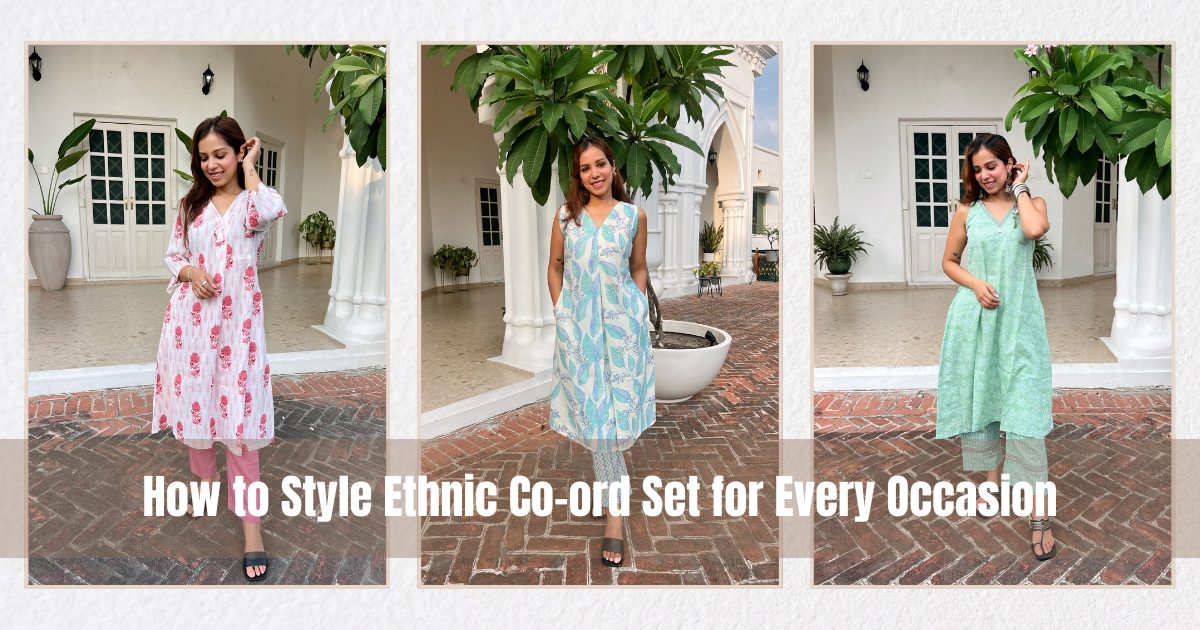
A co-ord set is the one wardrobe category built to do more than one job. Buy it once, style it five different ways, and you have covered office, casual weekend, a festive evening, a friend’s party, and even a wedding-guest look, all from a single outfit. That versatility is exactly why co-ord sets have become one of the fastest-growing categories in Indian ethnic wear over the last two years, moving from a niche fusion pick to a wardrobe staple for women who want put-together without the effort of matching separates every morning.
This guide covers everything you need to actually wear a co-ord set well: what it is, how it differs from a kurta set, how to choose fabric and print, and most usefully a full occasion-by-occasion breakdown of how to style the same 2-piece set for office, casual outings, festive days, parties, and weddings. By the end, you will know exactly how to build a co-ord wardrobe that earns its cost-per-wear many times over.
Written by the Rangaari Style Team, Rangaari is a homegrown women’s ethnic wear brand from Pilibhit, North India, styling hand block printed co-ords, kurta sets and tunics for Indian and NRI women.
What Is a Co-ord Set? (And How It Differs From a Kurta Set)
A co-ord set, short for “co-ordinated set” is an outfit where the top and bottom are cut from the same fabric, print, and colour story, designed as one unit rather than styled together after the fact. In Indian ethnic and fusion fashion, a co-ord set typically means a cropped or fitted top (blouse-style, shirt-style, or a short kurti) paired with a matching bottom palazzo, wide-leg pants, a skirt, or dhoti pants.
The distinction from a kurta set matters: a kurta set pairs a long tunic-length kurta with a bottom, and reads as traditional ethnic wear. A co-ord set is shorter on top, more fitted through the silhouette, and sits closer to Indo-western, it borrows the “matching two-piece” logic of a western co-ord but keeps ethnic fabric, print, and craft. That makes it the natural next step if you already wear Indo-western fusion pieces and want something a little more rooted in Indian textile tradition.
Why Co-ord Sets Work as a Wardrobe Category
- No matching required. The top and bottom are pre-coordinated, so there’s zero guesswork on colour or print pairing.
- One purchase, many outfits. Because the pieces can also be worn separately, top with jeans, bottom with a plain shirt, a single co-ord set effectively gives you three outfits, not one.
- Occasion range. A cotton co-ord in a muted block print reads as casual-smart; the same silhouette in silk or georgette with embellishment reads as festive or party-ready.
- Flattering by design. A fitted or cropped top with a flared or wide-leg bottom is one of the most universally flattering ethnic silhouettes, balancing proportion across body types.
Co-ord Set Fabric and Print Guide
Fabric changes everything about how a co-ord set performs: comfort, formality, and season all shift with it.
| Fabric | Best For | Feel | Occasion Signal |
|---|---|---|---|
| Pure cotton / cotton-linen | Daily wear, office, casual outings | Breathable, structured | Everyday, smart-casual |
| Chanderi silk | Festive, evening events | Lightweight, lustrous | Festive-formal |
| Georgette | Party, evening, wedding-guest | Fluid, flowy | Party, evening |
| Rayon / Viscose | Casual, weekend | Soft, drapy | Everyday |
| Silk blend with embellishment | Wedding-guest, big festive events | Rich, structured | Formal-festive |
Print rule of thumb: hand block prints and smaller motifs read as more versatile and daytime-appropriate; larger florals, foil, or embroidered borders push the same silhouette toward evening and festive. If you are building a first co-ord set, start with a mid-tone hand block print in cotton, it transitions across the most occasions with the least effort, which is also the philosophy behind Rangaari’s own Saanjh Co-ord Set.
How to Style a Co-ord Set: Occasion by Occasion
This is the part that actually changes how often you wear the set. The base outfit stays the same – it’s the layering, footwear, and accessories that shift the read.
1. Office / Work-Appropriate Co-ord Look
A co-ord set can absolutely work for the office if you choose the right fabric and keep accessories minimal. Pick a cotton or linen-blend co-ord in a solid or small-print top with straight-leg or slightly flared palazzo, avoid crop tops that show midriff and anything sheer.
- Top: structured, waist-length, full or three-quarter sleeve
- Bottom: straight pant or a moderate flare palazzo, ankle or full length
- Footwear: block heels or closed flats
- Accessories: a single statement earring, no bangles that clink through meetings
- Layer option: a structured nehru jacket or blazer over the co-ord instantly reads corporate
If you want more workwear-friendly ethnic options in the same breathable fabrics, our tunics guide covers the body-type and fabric choices that carry over directly to co-ords.
2. Casual / Everyday Co-ord Look
For running errands, brunch, or a college day, the same co-ord set worn without the formality rules becomes effortless. Roll the sleeves, swap heels for sneakers or kolhapuris, and let the print do the talking.
- Top: crop or fitted, short sleeve
- Bottom: wide-leg palazzo or culottes for movement
- Footwear: white sneakers or flat kolhapuris
- Accessories: a canvas or jute tote, minimal jewellery
- Trick: tie the top in a front knot for a more casual, cropped silhouette
3. Festive Co-ord Look (Diwali, Navratri, Puja)
For festive days, upgrade the fabric to chanderi or georgette and lean into colour and embellished borders. A co-ord in this fabric range holds its own against a traditional kurta set while feeling lighter and more contemporary.
- Top: fitted or A-line, with a hint of embroidery or gota border
- Bottom: flared palazzo or a shaped skirt for movement (useful for Navratri dancing)
- Footwear: juttis or embellished heels
- Accessories: jhumkas, a maang tikka for Navratri, bangles
- Dupatta option: drape a coordinating dupatta over one shoulder for a more traditional festive finish
For a more traditional festive alternative in the same colour story, browse our kurta sets for women.
4. Party / Evening Co-ord Look
This is where georgette and silk-blend co-ords earn their place. Choose a co-ord with a fitted, slightly cropped top and a fluid, movement-friendly bottom, think a flared skirt-style bottom or dhoti pants rather than a straight palazzo.
- Top: fitted, sleeveless or cap sleeve, with sequin or foil detail
- Bottom: flared skirt-cut palazzo or dhoti pants
- Footwear: heels or stiletto depending on comfort
- Accessories: statement earrings, a clutch, minimal neckwear so the top’s detailing stays visible
- Hair and makeup: this is the one occasion where bolder makeup and a sleek hairstyle balance the fitted silhouette
5. Wedding-Guest Co-ord Look
A co-ord set can absolutely replace a lehenga for a daytime wedding function or a smaller, informal wedding event. Choose the most embellished, richest fabric in your co-ord wardrobe – silk blend with embroidery, sequin, or zari work.
- Top: structured, embellished, three-quarter or full sleeve for a more formal finish
- Bottom: heavily flared palazzo or a lehenga-style skirt bottom for volume
- Footwear: embellished heels or juttis with metallic detailing
- Accessories: statement jhumkas or chandbalis, a stack of bangles, a potli bag
- Dupatta: a contrasting or metallic dupatta elevates the co-ord to full wedding-guest formality
Co-ord Set vs Kurta Set vs Indo-Western Fusion: Which One to Choose
| Format | Silhouette | Formality Range | Best For |
|---|---|---|---|
| Co-ord Set | Cropped/fitted top + matching bottom | Casual to wedding-guest | Versatility across many occasions from one set |
| Kurta Set | Long tunic + bottom (+ optional dupatta) | Casual to festive | Traditional ethnic occasions, daily wear |
| Indo-Western Fusion | Mixed silhouettes (crop top + dhoti, jacket + palazzo, etc.) | Party to festive | Statement, trend-forward looks |
If you only have budget or wardrobe space for one new category this season, the co-ord set wins on cost-per-wear as it is the only format on this list that genuinely moves from office to wedding-guest with an accessory and footwear change alone.
Building a Co-ord Set Wardrobe: What to Buy First
- First purchase: a cotton or cotton-linen co-ord in a mid-tone hand block print earns the most wears across office and casual
- Second purchase: a chanderi or georgette co-ord in a richer colour covers festive and party
- Third purchase: a silk-blend embellished co-ord – the wedding-guest and big-event piece
This three-piece approach covers every occasion in this guide without over-buying, and each piece can also be worn as separates – the top with jeans, the bottom with a plain shirt which is the real value of the co-ord format.
The Rangaari Co-ord Collection
Rangaari’s co-ord sets are designed from Pilibhit, North India, with hand block prints, breathable natural fabrics, and inclusive sizing from XS to XXXL. Each set is built to move across the occasions covered in this guide without needing a second outfit.
- Saanjh Co-ord Set – hand block printed cotton, the everyday-to-festive starter
- Azure Cotton Co-ord Set – breathable cotton for office and casual wear
- White Floral Cotton Co-ord Set – a lighter, summer-friendly print
- Dark Blue Ikat Print Co-ord Set – a deeper tone that carries into evening
- Kurta Sets for Women – for a more traditional ethnic silhouette
- Short Kurtis for Women – for mix-and-match styling
Also worth reading:
- Kurta Sets for Women: The Complete Buying Guide
- Tunics for Women: Body Type, Fabric and Occasion Guide
- Short Kurtis for Women: The Complete Guide
- Kurta vs Kurti vs Tunic: What’s the Difference?
Frequently Asked Questions About Co-ord Sets
What is the difference between a co-ord set and a kurta set?
A co-ord set has a shorter, more fitted top (crop or waist-length) paired with a matching bottom, sitting closer to Indo-western in silhouette. A kurta set has a longer, tunic-length top and reads as more traditional ethnic wear. Both are “matched” outfits, but the co-ord’s shorter top and more structured cut make it more versatile across casual-to-party occasions, while a kurta set leans more traditional and festive.
Can a co-ord set be worn for a wedding?
Yes, especially for daytime functions, mehendi, sangeet, or smaller informal wedding events. Choose a co-ord in a rich fabric like silk blend, georgette with embellishment with a heavily flared palazzo or skirt-style bottom, and pair it with statement jewellery and an embellished dupatta for full wedding-guest formality. For very formal, large weddings, a lehenga or a 3-piece kurta set may still feel more traditional, but the co-ord is a legitimate and increasingly popular alternative.
Are co-ord sets office-appropriate?
Yes, if you choose the right fabric and cut. A cotton or linen co-ord with a structured, waist-length top (not a cropped midriff-baring style) and a straight or moderately flared palazzo works well for office wear. Keep accessories minimal and consider layering a blazer or nehru jacket over the set for a more corporate finish.
Can the top and bottom of a co-ord set be worn separately?
Yes, this is one of the biggest advantages of the format. The top can be styled with jeans or trousers for a fusion look, and the bottom can be paired with a plain shirt, blouse, or a different kurti. Buying a co-ord set effectively gives you three outfit combinations from one purchase.
What fabric is best for a co-ord set in Indian summer?
Pure cotton or a cotton-linen blend. These fabrics breathe well and stay comfortable through the heat, and hold their shape better than rayon or georgette in humid conditions. Save chanderi, georgette, and silk-blend co-ords for the festive season from October through February.