
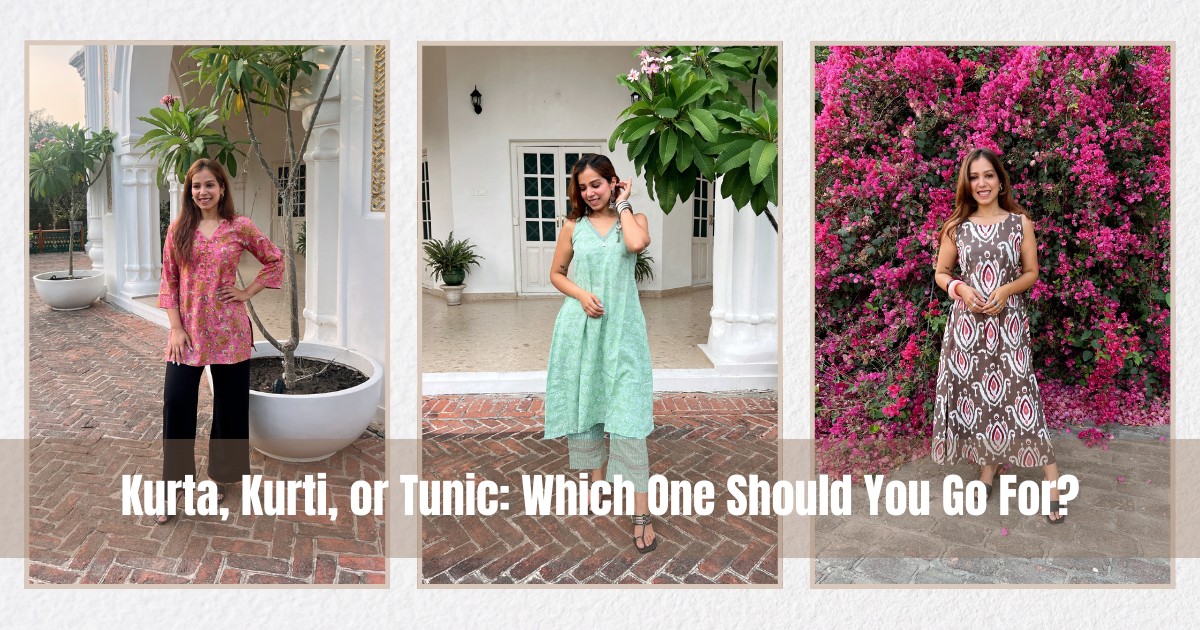
Kurta, kurti, or tunic – for most Indian and NRI women shopping online, the confusion is real and the stakes are higher than they look. Get the wrong one and you have a top that is too long, too short, too traditional, or simply not what you needed. This guide answers the practical question: which one actually fits the life you are living, and what to order when you are not sure of your size?
Quick answer: A kurta is a longer, traditionally rooted Indian top (thigh to knee). A kurti is a shorter version of the kurta (hip to mid-thigh), more casual and everyday. A tunic is a modern, Western-leaning short top at hip to thigh length with minimal ethnic detailing. If you are unsure of your size when ordering online, a kurta gives you the most forgiving fit, the length is generous and draping, so fit variations matter less than they do with a shorter, tighter kurti or tunic.
Kurta vs Kurti vs Tunic: Full Comparison
| Feature | Kurta | Kurti | Tunic |
|---|---|---|---|
| Length | Mid-thigh to knee (sometimes longer) | Hip to mid-thigh | Hip to thigh |
| Roots | South Asian traditional – derived from the Mughal-era kurta | Short form of kurta – more casual, everyday Indian | Western / fusion – casual modern |
| Fit | Relaxed, draping; generous chest and shoulder allowance | Fitted to semi-fitted at the bust, relaxed below | Relaxed; often straighter cut with less ethnic shaping |
| Detailing | Embroidery, prints, hand-block, mirror work; full side slits | Prints, ethnic motifs, minimal embroidery; partial side slit | Minimal – contemporary prints, solids, simple patterns |
| Paired with | Salwar, palazzo, cigarette pants, leggings | Leggings, jeans, palazzos, cigarette pants | Jeans, leggings, shorts, palazzos |
| Occasion | Festive-lite, semi-formal, office (with salwar), daily Indian wear | Daily wear, casual office, errands, college | Casual daily, weekend, fusion looks |
| Size forgiveness | High – long draping length hides fit variation | Medium – shorter length means shoulder/bust fit matters more | Medium – similar to kurti; shoulder and sleeve length more visible |
| NRI suitability | Excellent for Indian occasions and festivals abroad; packs flat | Great everyday Indian-casual – balances traditional and modern | Highest everyday casual crossover to Western wardrobes |
Also see: Tunic vs Kurti – what’s the difference and which to wear? for a focused two-way comparison of those two styles.
What Is a Kurta?
A kurta is a long, loose-fitting top that reaches from the shoulders down to the mid-thigh or knee. It is the foundational garment of traditional South Asian women’s daily dress worn across India, Pakistan, Bangladesh, and the South Asian diaspora for everyday life, festivals, and semi-formal occasions. The kurta has its roots in the Mughal-era garment tradition, originally a men’s garment that became a staple of Indian women’s dress over several centuries.
The women’s kurta is typically cut with generous fabric, wide sleeves, a relaxed chest, and a length that sits at or below the mid-thigh. It is almost always worn with a bottom: a salwar (loose trousers gathered at the ankle), a palazzo (wide-leg trouser), or cigarette pants. The full kurta-salwar set is one of the most practical, comfortable, and culturally flexible outfits for Indian women.
For NRI women, the kurta is often the item that connects daily life abroad with an Indian wardrobe. A plain cotton kurta with a straight-cut palazzo works equally well in a London grocery run and a family lunch in India. It is one of the rare Indian garments that travels across contexts without requiring adjustment.
Fabric matters enormously in a kurta: cotton kurtas are the everyday standard (breathable, easy to wash, does not crease badly), while embroidered or block-print kurtas in cambric, chanderi, or mul cotton are better suited to occasions.
What Is a Kurti?
A kurti is the short-form of the kurta. It is in essence, a kurta that has been cropped to the hip or mid-thigh. The word kurti is a diminutive (“little kurta”) and captures exactly what it is: all the ethnic character of the kurta in a shorter, more casual, more versatile format.
Kurtis emerged as a mainstream garment category in the early 2000s, driven by younger Indian women who wanted ethnic Indian wear that was comfortable with jeans and did not require a full bottom garment like a salwar. A kurti worn over straight-leg jeans or leggings is now one of the most ubiquitous Indian everyday looks, from colleges to offices to weekend outings.
The kurti retains most of the ethnic detailing of the kurta, prints, hand-block patterns, side slits, V-necks with piping, but in a shorter format that is easier to move in and easier to pair. Its length (roughly hip to mid-thigh) means that the chest and shoulder fit are more visible than on a full-length kurta: if you order online and the shoulders are slightly too wide, it will show more on a kurti than on a long draping kurta.
Short kurtis above the mid-thigh have their own identity and are extremely popular for jeans pairings. See our guide on short kurtis for jeans for specific length and fit advice.
What Is a Tunic?
A tunic is a Western-origin short top that, in the Indian market, has come to overlap heavily with the kurti. The key distinction is in the styling DNA: a tunic has minimal ethnic detailing, no piping, no mandarin collar, no traditional Indian motif and instead relies on contemporary prints, solids, and simple shapes. It is the most “fusion” of the three garments.
In practice, many Indian women use “kurti” and “tunic” interchangeably, and brands sometimes label the same garment both ways depending on the market they are targeting. The clearest rule of thumb: if it has a traditional Indian neckline (mandarin/Chinese collar, V with embroidered piping, keyhole), it is probably a kurti; if the neckline is simple and Western (round neck, boat neck, square neck), it is more likely a tunic.
For NRI women, the tunic is often the easiest entry point: it integrates into a predominantly Western wardrobe without looking out of place. A cotton tunic worn with jeans reads as “casual top” to a Western eye and as “Indian casual” to an Indian one, it works in both cultural registers.
For a focused comparison between just these two styles, see Tunic vs Kurti: what’s the difference and which to wear.
The NRI Size-Uncertainty Problem – and How to Solve It
For NRI women buying Indian ethnic wear online, the inability to try before you buy is a real and persistent problem. Indian sizing does not map neatly to UK, US, or Australian sizing and even within India, a “Medium” from one brand sits very differently from a “Medium” at another. This section is specifically for NRI and global buyers who are ordering from Indian brands for the first time.
Which garment to order if you are unsure of your size?
If you have any uncertainty about fit, order the kurta first. Here is why:
- Length covers fit variation. A kurta’s extra length means that if the shoulders are slightly wider than expected or the waist is less fitted than you imagined, it will still look intentional, the draping and length absorb fit variation in a way that a shorter kurti or tunic cannot.
- Side slits add flexibility. Most kurtas have deep side slits from the mid-hip down, which means even a slightly narrower-than-expected cut will not restrict your movement or look pulled.
- It is easier to style downward. A kurta that feels a touch large can be worn belted. A kurti that runs large looks shapeless and much harder to rescue without tailoring.
- The bust point matters less on a kurta. Kurtas are typically cut with 4–6 inches of ease at the bust, so a one-size variation (ordering an S instead of an XS, for example) usually still looks good. On a fitted kurti, that same one-size variation can mean the garment pools at the chest or pulls across the back.
When a kurti is the safer choice over a kurta
If you are petite (under 5’2″ / 157 cm), the length of a full kurta can overwhelm your frame, it may hit at the ankle or below rather than at the mid-thigh. In this case, a kurti is the more reliably flattering choice, since its shorter length is designed to sit at the hip and look proportional on petite frames. Order using the brand’s chest measurement in centimetres rather than the size label, and add 2–4 cm ease for a comfortable fit.
Rangaari size guide for NRI buyers
Rangaari sizes run XS to XXXL. As a general guide:
| Rangaari Size | Approximate Chest (cm) | Approximate Chest (inches) | UK Size equivalent | US Size equivalent |
|---|---|---|---|---|
| XS | 76–80 | 30–31.5 | 6–8 | 2–4 |
| S | 80–86 | 31.5–34 | 8–10 | 4–6 |
| M | 86–92 | 34–36 | 10–12 | 6–8 |
| L | 92–98 | 36–38.5 | 12–14 | 8–10 |
| XL | 98–104 | 38.5–41 | 14–16 | 10–12 |
| XXL | 104–110 | 41–43 | 16–18 | 12–14 |
| XXXL | 110–116 | 43–45.5 | 18–20 | 14–16 |
Note: these are generalised conversion guides. Ethnic wear typically has more ease than fitted Western garments of the same nominal size. When in doubt, go up one size for a kurta and true-to-size for a kurti or tunic. Contact Rangaari at [email protected] for specific garment measurements before ordering.
Occasion Guide: Which to Wear When
| Occasion | Best choice | Why |
|---|---|---|
| Daily casual (home, market, errands) | Kurti or Tunic | Shorter, easier to move in, pairs with everyday bottoms |
| Office (conservative) | Kurta with salwar or cigarette pants | Appropriate length + coverage for professional settings |
| Office (casual / creative) | Kurti with straight trousers or palazzos | Smart-casual; easy to dress up with minimal accessories |
| College / university | Kurti with jeans or leggings | Comfortable, culturally familiar, easy to move in |
| Family function / festive | Embroidered kurta with salwar | Traditional detailing, appropriate length for elders |
| Travel (long-haul, India visits) | Cotton kurta or kurti | Non-creasing cotton; packs flat; works in airports and family homes |
| Weekend casual (NRI) | Tunic with jeans or casual trousers | Western-friendly silhouette; integrates into a mixed wardrobe |
What Rangaari Makes
Rangaari is based in Pilibhit, Uttar Pradesh – an area with a long handloom and textile tradition. The brand’s core product range covers kurtis, tunics, and coordinated sets in soft breathable cotton, in sizes XS to XXXL. All garments are designed for Indian women’s daily wear: the fabrics are machine-washable cotton, the prints are Indian (block-print, floral, ikat), and the sizing is inclusive.
Browse: Rangaari Tunics · Kurta Sets · Short Kurtis
For home wear options – kaftans and loungewear – see our guide: Kaftan, Loungewear Set, or Nightwear? How Indian Women Choose Home Comfort Wear.
Frequently Asked Questions
What is the difference between a kurta and a kurti?
A kurta is a long Indian top reaching the mid-thigh or knee; a kurti is the shorter version of the same garment, cropped to the hip or mid-thigh. Both have traditional Indian roots and similar detailing (prints, side slits, ethnic necklines), but the kurti is more casual and pairs easily with jeans, while the full kurta is better suited for semi-formal and traditional occasions.
Is a tunic the same as a kurti?
They are closely related and overlap heavily in length and wearing style, but they differ in design roots. A kurti carries traditional Indian detailing (ethnic necklines, side slits, Indian motifs), while a tunic is Western-leaning with simpler, more contemporary styling. In practice, many Indian brands use the terms interchangeably. See also: Tunic vs Kurti.
What should an NRI buy – a kurta, kurti, or tunic?
For NRI women who want versatility, a kurti is usually the best starting point: it is casual enough for everyday wear abroad and ethnic enough to work in Indian contexts. For festive or family occasions, a kurta is more appropriate. For women with primarily Western wardrobes, a tunic integrates most naturally with existing clothes.
What size should I order as an NRI buying Indian ethnic wear online?
Always use the brand’s chest measurement in centimetres, not the size label. Indian “Medium” can range from 86 to 92 cm across brands. If you are between sizes, size up for kurtas (the extra length and ease are forgiving) and go true-to-size for kurtis and tunics (the shorter length means fit is more visible). When in doubt on your first order from a new brand, the kurta is the safest choice, its draping length absorbs fit variation better than a shorter kurti.
Can a kurta be worn without a salwar or dupatta?
Yes. A women’s kurta worn with straight-leg jeans, palazzos, or cigarette pants (no dupatta) is a completely standard Indian casual look. The dupatta is optional, it adds formality and tradition when you want it, but is not required for everyday wear. A long cotton kurta with wide-leg linen trousers is a popular contemporary styling choice.
Which is better for Indian summers – a kurta, kurti, or tunic?
In terms of comfort in Indian summer heat, the kurti and tunic have a slight edge because of their shorter length and therefore less fabric against the body. However, a full-length cotton kurta in mul cotton or light khadi is equally breathable if the fabric is right. The fabric matters more than the garment type in Indian summers – always choose 100% cotton over synthetic blends regardless of which you pick.
What is a kurta set?
A kurta set is a co-ordinated outfit that pairs the kurta with a matching bottom – typically a salwar, palazzo, or straight pant in the same fabric and print. Kurta sets remove the need to match separates and are the traditional, easy-to-wear everyday Indian outfit. They are especially popular for office wear and semi-formal occasions where a cohesive ethnic look is appropriate.
Comment (1)
Comments are closed.